On Saturday, October 10, 2026, Prime Minister Shehbaz Sharif inaugurated the newly renamed Daanish IT Park in Islamabad, describing the country's first modern national technology facility as a milestone for Pakistan's economic progress and prosperity. The launch brought together one of Pakistan's most talked-about development themes: turning a young, tech-hungry population into a digital workforce.
The announcement matters for more than its ceremony. With IT parks, startup incubation, a mandatory AI course for university students, and small tech centers spreading across districts, Pakistan's digital push is moving from promises to physical infrastructure. Here is what the Daanish IT Park actually is, how it will be run, and what it means for students, freelancers, and young professionals.
What exactly is the Daanish IT Park?
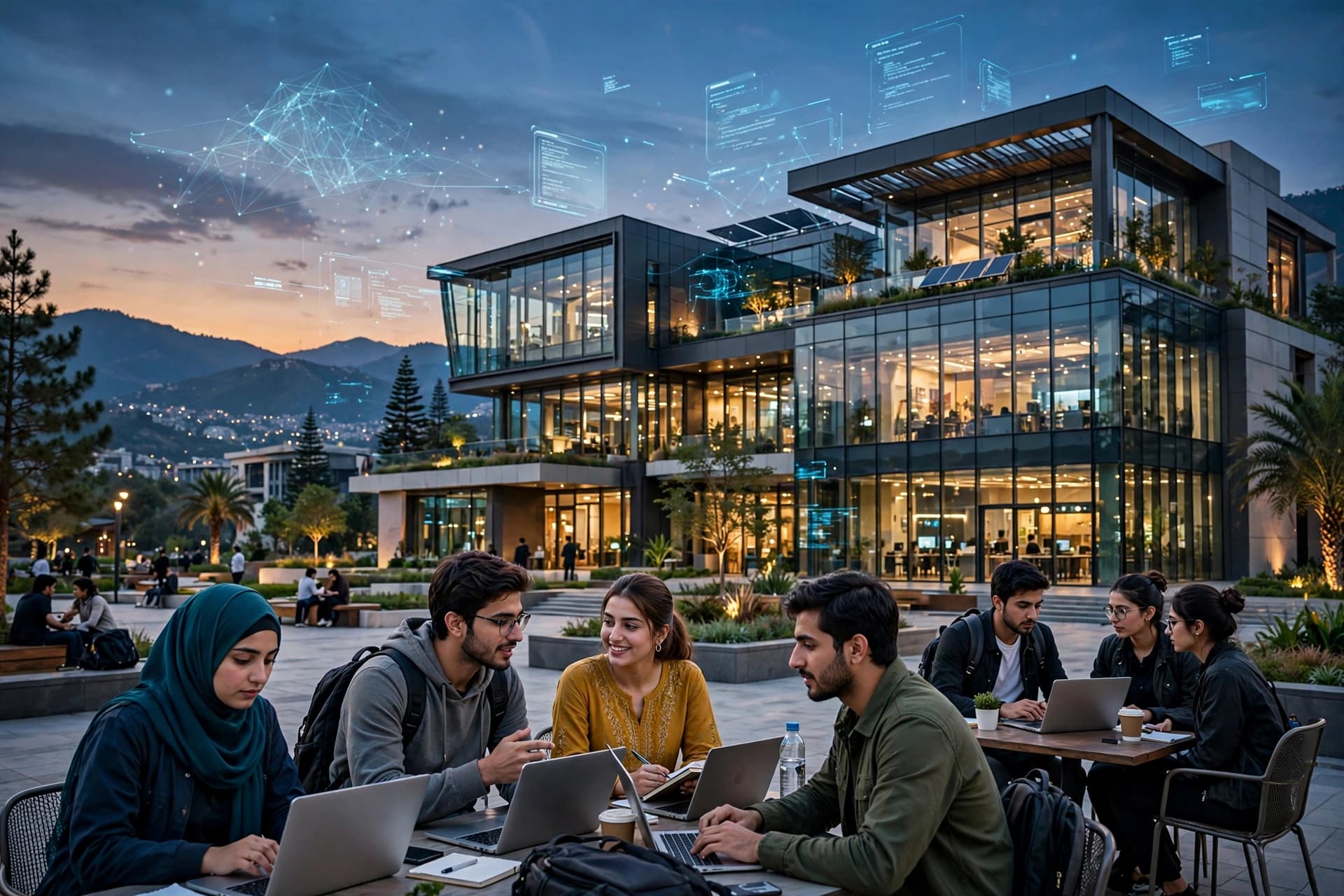
The Daanish IT Park, formerly the National Technology Park, is described by the government as Pakistan's first IT park developed along modern technological lines. Rather than a single office building, it is designed as an ecosystem: incubation centres, innovation hubs, start-ups, small and medium-sized enterprises (SMEs), industrialists, teachers, and students are meant to work under one roof.
The focus is squarely on skills. The prime minister said the facility would equip and empower not thousands but hundreds of thousands of young people with skills in information technology and artificial intelligence, helping Pakistan compete with developed economies. He also said AI and IT could benefit sectors ranging from agriculture and manufacturing to industry and mining, allowing the country to benefit from "modern knowledge."
The plan does not stop at Islamabad. The prime minister said that once the Islamabad facility becomes fully operational, similar parks could be established across all four provinces, as well as in Azad Jammu and Kashmir and Gilgit-Baltistan.
Who will run it — and why that matters
One of the most interesting details of the inauguration was the management model. The prime minister announced that the government itself would not run the facility. Instead, operations will be handed to a company selected through a transparent bidding process.
Local and international companies working in information technology and artificial intelligence will be invited to bid, and the building will go to the company offering the best services under the most favourable terms and conditions. The prime minister stressed that bidding should be conducted transparently and that the day-to-day running would be handled by experts and teachers.
This is a notable choice. Government-run technology projects in Pakistan have a mixed record, and an operator selected on merit, rather than a ministry department, gives the park a better chance of staying modern and useful. The real test, of course, will be who wins the bid and how quickly programmes for young people actually start.
Why the name "Daanish"?
The park's renaming links it deliberately to the Daanish school system, which provides educational opportunities to children from underprivileged backgrounds. The prime minister highlighted that thousands of children from poor backgrounds had benefited from Daanish schools, with graduates going on to become doctors, engineers, scientists, and teachers, while others pursued higher education at international universities.
He also referred to plans for Daanish universities as part of a broader effort to expand educational opportunities. The message is symbolic but clear: the IT park is positioned not just as an elite tech hub, but as part of a pipeline meant to give talented young Pakistanis from modest backgrounds a path into the digital economy.
A project eight years in the making
The prime minister acknowledged that the project had experienced considerable delays. Its foundation stone was laid in 2018, and he said his concern had been not only to complete the project during his government's tenure but to ensure young Pakistanis could benefit from the facility without further delay.
He declined to discuss the political circumstances behind the delay, saying the inauguration should focus on development rather than political point-scoring. He credited ministers Ahsan Iqbal, Ahad Khan Cheema, and IT Minister Shaza Fatima Khawaja, along with their teams, for bringing the project to completion.
The bigger digital picture
The IT park is one piece of a wider digital push. At the inauguration, IT Minister Shaza Fatima Khawaja highlighted the government's digital outreach through public-private partnerships: small technology centers have been established in sixty-five districts over the last two years, and one hundred and thirty-five of these centers are currently providing youth with round-the-clock internet access to polish their skills.
Meanwhile, artificial intelligence is entering Pakistan's classrooms. The Higher Education Commission has announced a mandatory three-credit-hour AI course for undergraduate and postgraduate programmes, beginning with the 2026 academic session. The goal is to integrate AI into higher education rather than leaving students to figure it out on their own.
These moves share a common logic: Pakistan has one of the youngest populations in the world, and its IT sector and freelance community are already earning foreign exchange. The bet is that physical hubs, campus curricula, and district-level connectivity can turn that raw demographic advantage into skilled, export-ready workers.
Also in Pakistan this week
In a second major development for the economy, Finance Minister Muhammad Aurangzeb departed on October 10, 2026, to lead Pakistan's delegation at the IMF and World Bank Annual Meetings in Bangkok, which run from October 12 to 18. According to the Finance Division, he has more than 60 high-level engagements lined up, including meetings with all three major credit rating agencies — Fitch, Moody's, and S&P.
The meetings follow the staff-level agreement reached with the IMF on October 7, which could unlock about $1.2 billion in financing once approved by the IMF's Executive Board. Pakistan's sovereign ratings currently sit in the single-B band at all three agencies, below investment grade. The Finance Division has not announced that any new loan or deal will be signed in Bangkok; the stated purpose is to explain Pakistan's reforms to lenders, investors, and rating agencies.
What this means for you
If you are a student, freelancer, or young professional in Pakistan, here is how to think about these developments:
Skills are the currency. The Daanish IT Park and the district tech centers are built around IT and AI skills. The earlier you start learning programming, data skills, AI tools, or digital design, the better positioned you will be when these facilities open their programmes to the public.
Watch for real programmes, not just announcements. The park's management will be handed to a bidding winner. Training courses, incubation applications, and SME onboarding will matter more than the inauguration itself. Follow announcements from the IT ministry and the park's operator for how to apply.
AI literacy is becoming official. With a mandatory AI course entering university curricula, students who already use AI tools thoughtfully — verifying answers, questioning sources, and using AI as a starting point rather than the final answer — will have a head start.
The economy's direction affects your earnings. Freelancers and remote workers earning in dollars benefit from stability: better credit ratings and steady reserves mean lower borrowing costs and a steadier rupee. The Bangkok meetings are one step in that story.
Pakistan's digital ambitions are not new, but a physical national technology park, district-level tech centers with round-the-clock internet, and AI in the university curriculum add up to something more concrete than a slogan. The Daanish IT Park will be judged by what happens inside it over the next few years — the startups it incubates, the students it trains, and the jobs it helps create.
Sources
- The Express Tribune, "PM Shehbaz inaugurates IT Park to drive tech-led growth" (October 10, 2026): https://tribune.com.pk/story/2634073/pm-shehbaz-inaugurates-it-park-to-drive-tech-led-growth
- WE News English, "Pakistan Inaugurates Daanish IT Park To Boost Digital Economy And Youth Skills" (October 11, 2026): https://wenewsenglish.com/pakistan-inaugurates-daanish-it-park-to-boost-digital-economy-and-youth-skills/
- Sabah News, "PM Shehbaz reaffirms the govt's commitment to youth empowerment" (October 11, 2026): https://sabahnews.net/english/news/pm-shehbaz-reaffirms-the-govts-commitment-to-youth-empowerment/
- Business Recorder, "National Technology Park renamed 'Danish IT Park'" (October 11, 2026): https://www.brecorder.com/news/amp/40443644
- PakEra, "Pakistan Finance Minister in Bangkok: 60 Meetings, 3 Raters" (October 11, 2026): https://pakera.pk/aurangzeb-bangkok-imf-world-bank-meetings-rating-agencies-october-2026/
- Pakistan Today, "AI should not make learning effortless" (October 11, 2026): https://www.pakistantoday.com.pk/2026/10/11/beyond-easy-answers