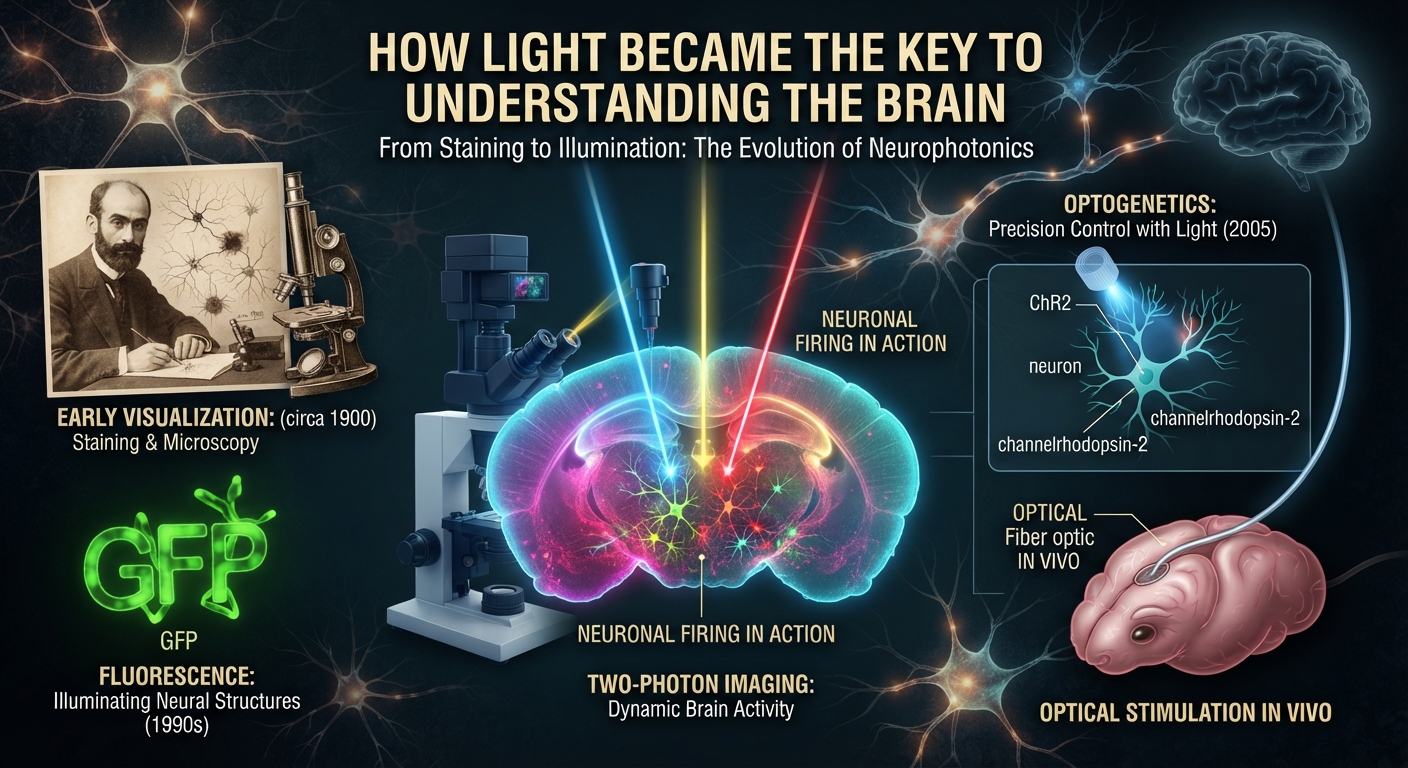
On Monday, October 5, 2026, the Nobel Assembly at the Karolinska Institutet in Stockholm announced this year's Nobel Prize in Physiology or Medicine. The winners: Karl Deisseroth, a 54-year-old American researcher at Stanford University; Peter Hegemann, 71, of Humboldt University in Berlin; and Georg Nagel, 73, of the University of Würzburg in Germany. The prize — 12 million Swedish kronor, roughly $1.2 million, shared equally among the three — honors their work on a technique called optogenetics: a way to switch individual brain cells on and off using pulses of light.
It is one of those rare Nobel Prizes where the winning story reads almost like fiction. It began not in a brain lab, but in pond water.
A mystery hiding in pond water
Back in the 1990s, Peter Hegemann was working at the Max Planck Institute for Biochemistry in Germany when a deceptively simple question caught his attention: how does a single-celled green alga called Chlamydomonas swim toward light? The organism has no eyes, no brain, no nervous system — yet it knows where the light is and moves toward it.
The answer, Hegemann discovered, was a special protein in the alga's membrane that reacts to light. In the 2000s, he teamed up with Georg Nagel, then at the Max Planck Institute for Biophysics in Frankfurt, to characterize this protein properly. What they found was remarkable: the protein acts as a tiny gate. When light hits it, the gate swings open and lets charged particles (ions) flow through. They named it channelrhodopsin — a light-gated ion channel.
At the time, this was fascinating biology, but nobody knew it would one day revolutionize how we study the human brain. As one Nobel committee member put it during the announcement, the two scientists had "just discovered the switch neuroscientists had long dreamed of."
The moment everything changed
Enter Karl Deisseroth. At Stanford University in California, Deisseroth looked at the channelrhodopsin discovery and saw something nobody else had seen: a universal remote control for nerve cells.
Here's the idea. Nerve cells — neurons — communicate through electrical signals. If you could insert the gene for channelrhodopsin into a specific set of neurons, those neurons would become sensitive to light. Shine a blue light on them, the channels open, ions rush in, and the neuron fires. Turn the light off, and it goes quiet. Using genetic engineering, scientists could choose exactly which neurons got the switch, and using light, they could flip those neurons on or off with millisecond precision — without touching any of the millions of neighboring cells.
Deisseroth's team published its landmark result in 2005, showing the approach worked in nerve cells taken from rats. A year later, the technique got its name: optogenetics. In 2007, his group took it a step further, stimulating specific neurons in the brains of living mice through a slender fiber-optic cable — and watched the mice's whiskers twitch in response.
It worked exactly as dreamed. For the first time in history, scientists could do more than watch the brain work. They could reach in, activate one precise circuit, and ask: what happens now?
From watching to understanding
Why was this such a big deal? Because for most of neuroscience's history, researchers could only observe correlations. They could see that a certain brain region lit up when a person felt fear, or that damage to another region wiped out a memory. But correlation is not causation. They couldn't prove which neurons actually caused a behavior, an emotion, or a memory.
Optogenetics changed the rules. By switching specific neuron groups on and off in living animals, researchers established direct, causal links between brain circuits and behavior. The technique was adopted by laboratories around the world almost overnight, and it has since been used to map the neural networks behind pain, attention, sleep, memory formation, and social behavior.
It has also opened new frontiers in studying severe mental and neurological conditions. Today, optogenetics is helping researchers investigate the circuit-level causes of schizophrenia, depression, Alzheimer's disease, and Parkinson's disease — disorders where the brain's wiring goes wrong, but where exactly has always been the hardest question to answer.
The tools keep getting better, too. Since the original discovery, scientists have found more light-sensitive proteins that respond to different colors of light, giving them even finer control. Some act as "off" switches that silence neurons, completing the toolkit.
From laboratory tool to real treatment
Perhaps the most exciting part of this story is that optogenetics is already taking its first steps toward helping real patients. The most promising application so far is in restoring vision.
Many forms of blindness are caused by the loss of the light-detecting rod and cone cells in the retina. But the retina's other nerve cells are often still intact. In 2021, researchers used an optogenetic approach to make those surviving retinal nerve cells respond directly to light, and a blind patient with a disease called retinitis pigmentosa — which affects nearly two million people worldwide — partially recovered his vision, regaining enough sight to find and pick up objects around him. The treatment requires the patient to wear special light-stimulating goggles, and several clinical trials using this approach are now ongoing.
Similar work is exploring whether optogenetics can help restore hearing, and whether it can inform new treatments for neurological and psychiatric disorders. It is still early — one of the laureates himself noted that only a handful of patients have benefited from the technique so far. But the path from laboratory tool to medical treatment is open, and researchers are walking it.
The technique has one important limitation: light cannot penetrate very far into the body. That is why research is underway on equivalent approaches that use ultrasound or magnetism instead of light — carrying the same idea of precise, remote control of neurons into deeper tissue.
A story worth telling students
Beyond the science itself, this Nobel Prize carries a lesson that students everywhere — including in Pakistan — should hear. The discovery that won one of the world's most prestigious prizes began with a scientist being curious about pond scum. Nobody was looking for a brain-control technology. Hegemann was just trying to understand how an alga swims toward light.
That is how basic, curiosity-driven science works. It rewards patient observation and honest questions, and sometimes it produces tools that transform medicine decades later. For young scientists in Pakistan and around the world, the message is clear: you don't need a billion-dollar lab to change the world. You need a good question — and the persistence to follow it wherever it leads.
The optogenetics story also shows what collaboration across borders can achieve. German algae research met American neuroscience at exactly the right moment, and both halves were needed. Science, at its best, is a global conversation.
What happens next
The 2026 laureates now join a lineage of Nobel winners whose work redefined our understanding of the human brain. Their light switch has already illuminated circuits involved in memory, emotion, pain, and disease. In the coming years, watch for three things: clinical trial results for vision restoration, deeper applications in psychiatric research — where causal understanding has always been the missing piece — and new non-light-based control methods that push the same principle deeper into the body.
A century ago, the brain was a black box. Today, thanks to three scientists and a light-sensitive protein from pond water, we can flip its circuits on and off like lights in a house. The Nobel Committee's recognition is well-timed — and the brightest discoveries may still be ahead.
Sources
- CNN: "Nobel Prize in medicine awarded to trio for technique that helps decode mysteries of the brain" — https://www.cnn.com/2026/10/05/science/nobel-prize-medicine-karl-deisseroth-peter-hegemann-georg-nagel-intl?cid=external-feeds_iluminar_meta
- New Scientist: "Nobel prize for medicine goes to trio who developed optogenetics" — https://www.newscientist.com/article/2591980-nobel-prize-for-medicine-goes-to-trio-who-developed-optogenetics/
- The Hindu: "2026 Nobel medicine prize: Trio wins for optogenetics work" — https://www.thehindu.com/sci-tech/health/nobel-prize-physiology-medicine-2026-winner/article71545941.ece
- Le Monde: "Nobel Prize in Medicine 2026: One American and two Germans honored for technique activating neurons with light" — https://www.lemonde.fr/en/science/article/2026/10/06/nobel-prize-in-medicine-2026-one-american-and-two-germans-honored-for-technique-activating-neurons-with-light_6758285_10.html